
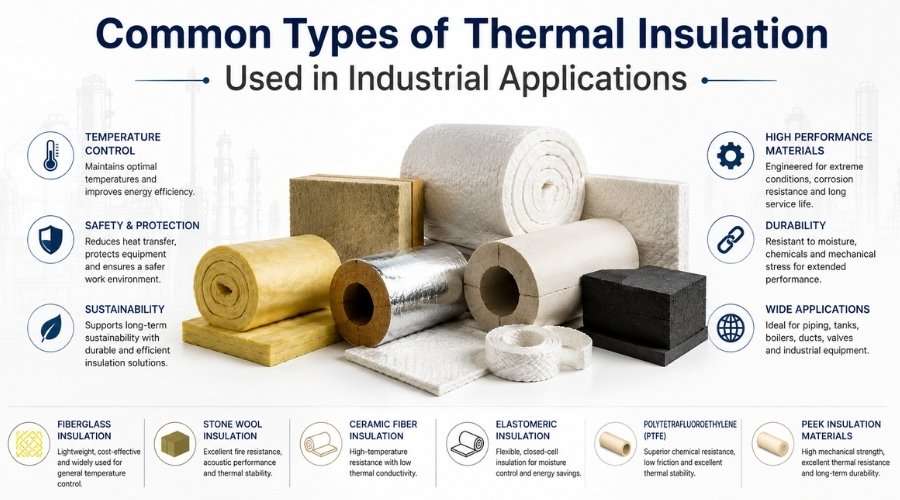
Heat is an important form of energy. For industry, wasted heat equals wasted money. Thermal insulation is the answer to maintaining a comfortable temperature in a furnace or a cold temperature in a storage tank. However, industrial insulation isn't just one type of insulation. It is a broad category with materials suited for specific environments, temperatures, and conditions. The article will detail the most prevalent applications of thermal insulation, how they work, and where they work best in industrial settings.
Insulation is familiar to most who live in homes and buildings. But industrial insulation is a different category altogether. It involves extremes, be it temperatures above 1000°C or much below freezing. It will withstand mechanical stress and constant vibration. Moreover, it must comply with rigorous safety and fire codes. Materials in the process areas have been designed to meet these conditions. It is important to select the right one. Selections can result in loss of energy output, equipment wear and tear, safety risk, and expensive downtime.
Need high-performance industrial thermal insulation materials? Request a quote now
Mineral wools are one of the most widespread insulations in industries. It is available in two basic types, rock wool and glass wool. Both are constructed from natural or recycled materials, which are spun into fibers and then crafted into blankets, boards, or pipe pieces.
This type of Wool is formed from volcanic rock. This is very temperature-resistant. There are grades capable of reaching temperatures of up to 750°C or higher. Additionally, it will absorb sound, which is an additional benefit in a noisy industrial setting.
Rock wool can be used for boiler, industrial piping, furnace, and storage tank insulation, etc. One of the most dependable and economical products for general industrial applications.
Glass wool is a fine fiber spun of recycled glass. Lighter than the rock wool, it is usually employed at lower temperatures (up to approx. 350°C). It can be found in HVAC systems, ducts, and building insulation at industrial facilities.
Rock wool and Glass wool can be easily cut and installed. These are readily available and inexpensive, which is why they are favorites in the industry.
Calcium Silicate is a high-performance, tough material with particle-based and rigid insulation. It's composed of silica and lime, sometimes reinforced with fibers. The result is a solid, compact block or pipe with a high dimensional stability at very high temperatures.
Find out where this works best
Calcium silicate will withstand temperatures to approximately 1000ºC in some formulations. Strong enough to walk on and resist damage to insulators in cases where workers must be able to get in to look at large equipment and vessels. It is also fairly moisture-resistant and resistant to shrinkage and deformation when hot.
It is commonly used in power plants, oil refineries, petrochemical plants, and various industrial piping systems. The places that involve high temperatures and require mechanical strength are strong indicators for Calcium Silicate.
Take note of just one thing
Calcium Silicate is heavier than most other insulators. This can cause considerable weight on structures and piping systems. This should be taken into consideration by engineers during system design.
Ceramic fiber is an insulation material that is specifically made from alumina and silica. It is designed for very high temperatures.
Lightweight with Excellent Heat Resistance
The advantage of ceramic fiber is its very lightweight. It will need to withstand extreme temperatures and be quite light. It is also minimal in thermal mass (fast to heat up and cool down). On this basis, it is suitable for use in processes with repeated temperature changes (batch furnaces, kilns, and others) that are often turned on and off.
Loose fill, ceramic fiber blanket, ceramic fiber boards, and ceramic fiber modules are all common types of ceramic fiber. It is used in petrochemical burners, ceramic kilns, and glass furnace production.
Handling Precautions
These ceramic fiber installations should be carried out with care. Only with proper protection, e.g., gloves, mask, goggles, most of the time will installation and maintenance be possible.
Microporous insulation is one of the most technically advanced types of insulation currently available. It's composed of fumed silica, pressed into boards or pliable pads in place of other materials. The structure has millions of small pores, which prevent air from dissipating heat, drastically reducing heat loss.
Exceptionally Thin and Effective
Microporous insulation's characteristic is extremely low heat conductivity, lower than that of still air. This means it delivers outstanding insulation performance in a very thin layer. Microporous panels can give the same effect as a considerably thicker section of traditional insulation in situations where space is at a premium.
It is used in industrial furnaces, fire protection systems, and high-temperature equipment, where reducing insulation thickness is important. It's more expensive than other materials, but whenever it works out in terms of space and weight savings, it makes sense.
Among all solids, aerogel is the lightest material. It is prepared by removing the liquid from a gel framework while preserving its solid structure. The result is a material with a high air content and outstanding insulating properties. Aerogel is one of the materials with the lowest thermal conductivity in industrial applications, has a wide operating temperature range, and is very lightweight. Aerogels pay for themselves in these applications where space, weight, and performance are of paramount importance. In many cases, they outperform competing products, mostly those of similar relative cost.
An excellent and widely used insulating material, known by the name polyurethane foam (PU foam). It has a very low k-value, which is useful because it provides a high insulating capacity even in thin walls. It bonds strongly to the surface and can be sprayed, poured, or applied as panels.
PU foam is most effective for low- to moderate-temperature uses. It is commonly used in cold storage, refrigerator systems, and industrial building panels. It's light, easy to apply, and closed-cell enables excellent moisture resistance.
The only limitation on its use is temperature. The PU foam can't be used for high-heat applications. It starts to degrade at temperatures above about 120°C for ordinary grades. Also, it may not be fire-resistant if a flame-retardant product is not used.
This foam is a flexible, closed-cell insulating material made of rubber. Easy to manage and soft. It is Bendable and tolerates flexing with ease for conforming to pipes, valves, fittings, and other special pipe shapes.
The Go-To Material for HVAC and Refrigeration Piping
It is highly resistant to moisture vapor due to its closed-cell structure. This is essential when using cold systems where condensation is always a problem. Poor or missing insulation on cold pipes reduces thermal insulation, causes drip damage to potable water systems, and leads to corrosion. This is prevented by elastomeric foam. It is present in commercial HVAC systems, chilled water pipes, refrigerant lines, and air-handling units.
Expanded polystyrene or extruded polystyrene are plastic foam boards suitable for various industrial and construction insulation applications. The white foam used in packaging is called EPS. The surface is smoother, and XPS is denser.
XPS is more moisture resistant than EPS and has slightly superior thermal properties. They are all lightweight, inexpensive, and easy to cut. They are common in the insulation of cold storage rooms, insulated floor slabs, building envelope insulation, and low-temperature insulated pipelines. Neither is heat-resistant. Both are applicable only with fire protection, and will be limited by fire in use where fire protection is an issue.
The real, mechanical strength of calcium silicate makes it stand out as unique. It can support physical loads, which is not possible with ceramic fiber or mineral wool; workers can step onto or stand on it, and it retains its shape when under load. Its structural integrity is preferred in power plants and refineries, where insulated surfaces allow regular maintenance access, and it also resists heat.
Cellular glass is produced when molten glass is blown into a form of rigid, closed-cell foam. It will not absorb water, is totally non-organic, and is not affected by rot or mold. It also withstands fire and a broad range of temperatures.
Where Cellular Glass Shines
Applications of cellular glass include insulation for chemical plants, cryogenic applications, and underground piping, where moisture could be disastrous. It is also applied to the bases of tanks and in areas with high compression loads. It is among the safest options for wet or buried locations, due to its impermeability. It's also not in a foam XPS form, but it is heavier and more expensive. When it comes to service life and moisture absorption, it is a worthwhile investment in the long run.
Start with the temperature. That being the case, many materials are ruled out straight away. Next, consider the environment, moisture, chemicals, the risk of fire, and physical access. Consider weight and space limitations. Lastly, determine all costs over the life of the service, not just the cost of materials. Each application has a material well-suited to it, and the job has to be done with care to find the best material, not necessarily the cheapest!
It is a volcanic mineral that becomes lighter when heated. The expanded form is a non-flammable and very light thermal insulator. It is used as loose-fill insulation in annular spaces, especially in storage tanks and liquefied natural gas containers, where a frozen space must be maintained within the vessel. Perlite is also incorporated into other insulation systems for high-temperature applications, such as furnace walls. It is low-cost and readily accessible, so it is practical for large-volume applications.
Thermal insulation materials used in industrial applications are not one-size-fits-all solutions. They consist of a wide range of materials, each specifically engineered to perform under different operating conditions, temperatures, and environmental challenges. Selecting the right insulation requires a clear understanding of these differences and how they relate to your specific application. Factors such as heat resistance, moisture exposure, mechanical strength, and safety requirements should all be considered. By matching the insulation material to actual operating conditions, industries can improve energy efficiency, enhance workplace safety, extend equipment lifespan, reduce maintenance needs, and achieve better long-term cost control.
Temperature sensitive products require more than a strong outer carton...
READ FULLHeat naturally transfers through walls, pipes, machinery, storage tank...
READ FULLHeat is an important form of energy. For industry, wasted heat equals ...
READ FULL