
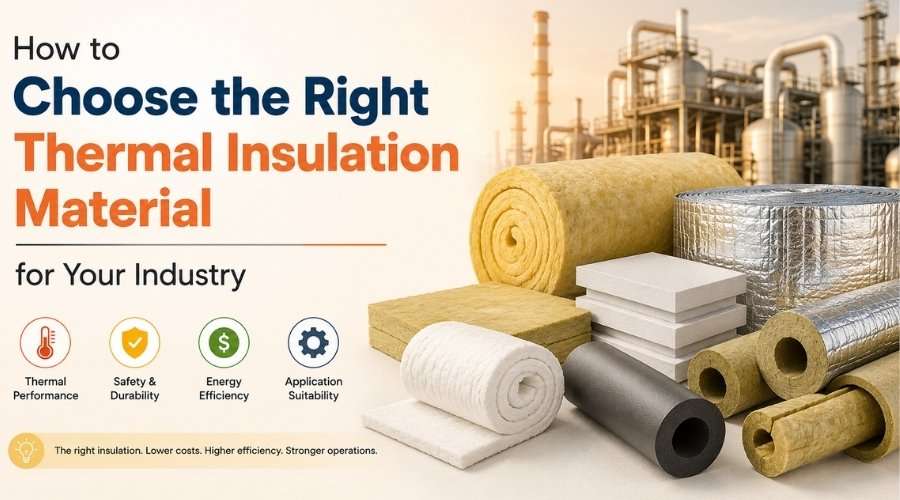
Heat naturally transfers through walls, pipes, machinery, storage tanks, and other industrial structures. When this heat movement is not properly controlled, it can lead to significant energy losses, higher operating costs, reduced equipment efficiency, and potential workplace safety hazards. However, selecting the right insulation material is not always easy. There are lots of choices, and each performs better under different circumstances than the others. This is the guide to understand everything to make the best choice for your industry.
You’ll know where to source quality insulation products at competitive prices and how to select the most suitable option for your specific operational needs. By understanding the strengths and uses of different materials, you can make a more informed and effective choice for your industry.
Thermal insulation is any material that slows down the transfer of heat. It serves as a barrier to. It retains heat where it should and prevents it from being retained where it shouldn't. Whether in the industrial field, this directly affects energy consumption, process efficiency, equipment lifespan, and worker safety.
When you do not make the right choices in insulation, the result is thermal loss, soaring energy costs, process fluctuations, and equipment deterioration. But the right insulation gets system components performing at their optimum, steadily and economically over the years.
It's helpful to have an overview of what makes the direst importance before exploring specific materials. Each industry will have its unique requirements. When a person selects one criterion (such as price), it can create issues later on.
Each insulator has a temperature range within which it will perform safely and effectively. Some materials can be effective in moderate-temperature areas but not in extreme-temperature areas. Always use the same material for the application's temperature range, with a safety factor.
Thermal conductivity is a measurement of the heat flow rate of a material. The lower the number, the better the insulating quality. Also referred to as the k-value or lambda value, this number is one of the most important ones to consider in comparing materials. The smaller the k value, the less heat will flow and the better the insulation.
In an industrial environment, the possibility of moisture, steam, chemicals, and oils is likely. Water absorptive insulation will lose its insulating properties in a flash. In addition, it can lead to rusting pipes, mold growth, and structural problems. Always test how a material reacts to the particular substances it will be exposed to in your facility when using a material.
Some insulation materials are fragile. They are unaffected by vibration or impact in protected spaces but deteriorate easily under these conditions. A material with sufficient mechanical strength is required for high-traffic areas or for equipment that vibrates.
In industries such as oil and gas, chemical, and construction, there are strict Fire Safety standards to be met. Insulation materials should comply with local fire codes and industry standards. Some materials have a natural ability to resist fire. Others are covered with multiple layers or require multiple coatings to meet the requirements. Always check for compliance before installation.
As insulation becomes thicker, it does a better job, but not all installations accommodate thick insulation. A very low k-value can mean the same level of performance in a thinner section of material in confined areas.
Once the application's factors are known, material selection can be matched more easily. This is a rundown of the top, regularly used industrial insulation materials.
Mineral wool is the most widely used industrial insulating material. There are two main types: rock wool and glass wool. Both are good thermal, fire, and sound insulators.
Rock wool can withstand high temperatures and is used in many industrial furnaces, boilers, and pipelines. Glass wool is lighter and is generally used for building insulation and HVAC systems. These are both affordable and easily accessible.
Calcium silicate is highly rigid and a high-temperature insulating material. It can withstand some temperatures as high as about 1000°C in some formulations. Strong, has good dimensional stability and moderate moisture resistance.
Ceramic fiber insulation is intended for use at very high temperatures, typically over 1000°C. Lightweight and with good thermal stability. It is also used in industrial and high-temperature processes, such as furnaces and kilns.
It has low thermal mass and heats up or cools down quickly in applications that require rapid temperature changes. Ceramic fiber, however, has to be handled carefully because of human health issues associated with the installation of airborne fiber.
Polyurethane foam is one of the lowest k-values on the market. Provides good insulation even at low thickness. It's lightweight, simple to apply, and adhesive to surfaces. It is commonly used in cold storage, refrigeration systems, and building construction. The downside of its use is that it's too delicate to withstand high temperatures. It is also not highly fire-resistant unless specially treated.
One of the most advanced insulation materials manufactured is aerogel. It has a very low k value and a good temperature range for performance. Very thin and lightweight, it is suitable for space-constrained applications. Aerogel is much more costly than traditional insulating materials. In other cases, with space constraints and performance requirements, the added cost is worth it, as in subsea pipelines, aerospace, and industrial equipment.
In insulation, these are used variably as insulating materials in building and building works. These items are easy to handle, lightweight, and inexpensive, and they are the best to invest in. XPS is better able to resist moisture than EPS and has slightly higher thermal resistance. Cold storage, building envelopes, and low-temperature piping are applications where they are suitable; they are not for high-temperature industrial applications.
Many pipes in HVAC and refrigeration systems are made from it. It is easy to install, moisture impervious, and flexible. It has closed cells, which prevent condensation, a concern in cooling systems. It would be mostly only for moderate temperature applications and not for usage in high temperatures.
Read this blog 4 Types of Thermal Insulation Used in Industrial Applications
The successful selection of material depends on the combination of temperatures, moisture, chemical susceptibility, and safety specifications for that particular industry. A cold storage requirement in a food processing plant calls for a moisture-protective, hygienic material, such as elastomeric foam or XPS. High-temperature pipes of a petrochemical refinery require calcium silicate or mineral wool. Matching material to industry isn't a matter of choice; it's a basis for a good insulation decision.
Choosing the right thermal insulation material involves more than simply comparing different material types. It is equally important to consider the specific industrial application and operating environment. Different industries have unique requirements based on temperature ranges, moisture exposure, fire resistance, energy efficiency goals, and equipment design. Whether insulation is used for pipelines, storage tanks, boilers, HVAC systems, or manufacturing equipment, selecting a solution tailored to the application ensures optimal thermal.
Hot or cold fluid is piped through industrial facilities. When they become insulated, they minimize heat gain or loss, condensation, and freezing. Insulation should be the same cross-section as the pipe being insulated. The fluid temperature and the environment the pipes are exposed to determine the material that should be used.
All tanks, vessels, and reactors require insulation to protect against process temperatures and to prevent worker exposure to hot surfaces. Usually employed are rigid materials such as calcium silicate boards or mineral wool boards. Ensuring consistent and easy installation, there are commands for custom shapes and pre-formed sections.
Condensation and energy loss occur in HVAC ducts, which require insulation. Typically, glass wool duct wrap and rigid foam boards. It also needs to exhibit a certain degree of acoustic isolation to prevent noise from being transmitted.
Its impact can increase energy costs or lead to actual material failure. Insulation material used beyond the temperature limits can crack or melt, thus exposing the equipment. Some materials are not damp-proof enough and can absorb moisture, becoming ineffective. Extreme cases can arise where a material is installed in a location where fire is a concern, and the wrong material is installed, rendering it unsafe and unable to meet code.
The first thing that needs to be considered is that no insulation is effective when it cannot be installed properly. These gaps, joints that are not yet sealed, and poor thickness levels can have a major depressing impact. Use correct accessories, jacketing, adhesives, and vapors as required, and follow the manufacturer's installation instructions. Also, maintenance is equally important.
No, and that's the keyword in this entire guide. There is no single material that fits all the requirements for all applications. There are advantages and disadvantages to each material. The combination of temperature, environment, mechanical requirements, fire safety requirements, and budget always conditions the selection. The best way to ensure that you will get the outcome you want is to know what you are up against when you choose a material for your work.
Use the operating temperature as a criterion to reduce the list of materials that can do that. Next, restrict the chemical and moisture exposure. Review a checklist for fire safety requirements in your industry and area. Consider the installation environment and mechanical strength. Next, and most importantly, compare costs - the material as well as installation and anticipated lifespan.
In any case, speak with a thermal insulation expert or the technical staff of a trusted manufacturer. They will be able to perform calculations, suggest products, and prevent expensive errors.
The choice of thermal insulation material can have a more profound impact on both monetary and safety implications. It is not a task to rush or base on price alone. Choose the right material to restrain energy costs, safeguard equipment, guarantee process effectiveness, and keep workers safe.
Research your needs. Match those properties with the materials. Work with a trustworthy supplier who offers technical support and documentation. Properly installed, a well-designed thermal insulation can be one of the biggest assets to the industrial operation.
When selecting a thermal insulation material, consider operating temperature, moisture resistance, fire safety requirements, durability, energy efficiency goals, installation conditions, and long-term maintenance costs to ensure optimal performance.
Materials such as ceramic fiber, calcium silicate, and mineral wool are commonly used in high-temperature environments because they offer excellent heat resistance, thermal stability, and protection for industrial equipment.
Thermal insulation minimizes heat loss and heat gain, allowing equipment and systems to operate more efficiently. This reduces energy consumption, lowers utility expenses, extends equipment lifespan, and improves overall productivity.
Temperature sensitive products require more than a strong outer carton...
READ FULLHeat naturally transfers through walls, pipes, machinery, storage tank...
READ FULLHeat is an important form of energy. For industry, wasted heat equals ...
READ FULL